last updated 22 June 2021
Contents: Browser Reviews | Browser usage guidelines | Paywalls (subscriptions) for popular news sites | .
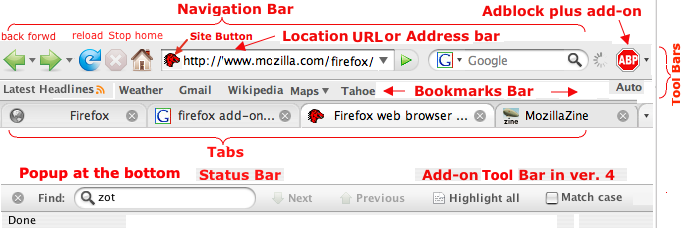
See Browser Toolbars & the Added Power of Branded Themes - Brand Thunder
Browser Ranks July 2021
1. Safari is best for Macs.
Mac guru's say to stick with Safari even though Chrome is quicker.
If you also use an iPhone and/or an iPad, then using Safari on your Mac will make for the most seamless transition between platforms.
It will improve battery life on iPhones, iPads and laptops.
Safari used about 5% to 10% less RAM than Chrome, Firefox and Edge in one test.<
2. Google Chrome may come packed with robust features and a huge collection of extensions, but it still has its flaws. Besides its numerous privacy issues, Chrome is also heavy on system resources, resulting in sluggish browsing or a depleted laptop battery.
Chromium is the open-source browser project started by Google behind Chrome. A lot of developers have forked Chromium to include unique features pertaining to privacy, multi-media, and security.
Most chrome extensions work on chromium browsers.
The Best Browser for Mac in 2020 | Digital Trends
New browsers Brave and
Vivaldi based on Chromium get good reviews.
Mac guru's say you should stick with Safari on a mac
Which Browser Is Best? | PCMag
Doesn't rank browsers, but had a good description of features and a chart with memory usage and test scores.
Firefox:
- The best browser for power users and privacy protection.
- Good privacy story, with a private mode that not only discards a session’s history and cookies but also hides your activities from third-party tracking sites during the private session.
- Fingerprint protection—preventing trackers from identifying you based on your hardware and software setup.
- Built-in Content Blocking to fend off known trackers and cryptocurrency-mining ploys.
- In the vanguard of supporting new HTML5 and CSS capabilities.
- Password management service called Lockwise, which can generate complex passwords, sync them between devices, and secure everything under a strong master password.
- Syncing with mobile devices. You can be reading a webpage on your desktop PC, and have it instantly open on your iPhone or vice versa.
- A Pocket button in the address bar, letting you save a page for later viewing anywhere with one click.
- A wealth of available extensions.
- The Reader View button de-clutters a webpage loaded with ads, promos, and videos, so you can peruse it with no distractions.
- Block autoplay to silence sound
- Doesn't work well with TurboTax
Tips:
Get Started with Firefox
Reader view for clutter-free web pages
Customize Firefox controls, buttons and toolbars
Firefox page here
Things I don't like:
History doesn't have date.
Have to grap the corner of the window to move it.
Chrome:
- 70% market share (except for Apple devices), so almost all developers test with it avoiding compatibility issues.
- High memory usage on Mac and Windows, which slows down speed.
Some background processes may be to improve speed on some web pages, but in general it slows down your system.
- Creates far more program processes than the others, to ensure stability
- Loads of features in Chrome that are only available to web geeks who can tinker in the about:flags settings
- The Chrome mobile browser is very capable, and offers syncing of bookmarks, passwords, and settings.
Tips:
How to Use Google Chrome’s Hidden Reader Mode to remove clutter.
Chrome page here
blen
Opera:
Opera is the only browser that includes a built-in VPN.
Safari:
- The default Mac and iOS browser is a strong choice, though its interface has some nonstandard elements on both desktop and mobile.
- Fingerprinting protection—preventing web trackers from identifying you by your system specs.
- Sign in with Apple feature to replace Facebook and Google as web account authorizers.
- Apple Pay support
- Handoff feature to continue browsing between iPhone and Mac.
- Safari used about 5% to 10% less RAM than Chrome, Firefox and Edge in one test.
- Safari browser has the best blend of privacy, performance and battery to offer on Macs according to July 2020 article in the Wall Street Journal
Edge:
- Better than Chrome on HTML5Test
- If you’re a Netflix watcher, Edge is the only web browser that lets you view shows in 4K.
- Reader mode. Not only does this offer distraction-free web article reading, stripping out ads and nonessential eye candy (or eye poison, more aptly)
2018 Reviews:
| Reviewer | | Chrome | Safari | IE - Edge | Firefox | Opera |
| Tech Radar | Rating | 2 | not rated | 4 | 1 | 3 |
| Pros | - Infinitely expandable
- Lots of tweaking options | | - Very fast
- Built-in reading mode | - Very fast
Light on system resources
(See benchmarks below)
- Strong privacy tools
- Well designed interface | Turbo Mode
Integrated ad-blocker |
| Cons | - Resource-hungry
- Privacy concerns thanks to Google Links | | Edge needs Win 10 | Some extensions don't work | Fewer plugins |
| TopTenReviews | Rating | 2 | 3 | 5 | 1 | 4 |
| Score | 9.8 | 9.6 | 9.1 | 9.8 | 9.5 |
| Pros | - Compatible with all platforms and devices
- Synchronization makes settings available on every device
- You can search the web from the address bar | Loads webpages quickly.
- telephone support | Telephone Support | - Navigates the web very quickly
- Blocks malware reliably
- Includes a private web browser | Uses the same base program as Google Chrome |
| Cons | Desktop version isn't as fast
Support
Extensions not searchable from the browser menu | Isn't compatible with Windows and Android operating systems.
You can't customize the toolbars. | Some compatibility Issues | Support
Bookmarks hard to find
| Not recognized by older websites, which may block your access to them |
| Digital Trends
| rating | 1 | not rated | 4 | 2 | 3 |
| Pros | Mobile compatibility
visable fav icons good | focuses a great deal on privacy and security | | visabe fav icons
more extensions
YubiKey authentication | |
| Cons | | Slower | | |
| Tech Advisor | Rating | 1 | 3 | 4 | 2 | 5 |
Usage Guidelines:
Many browsers (Chrome and Firefox have the worst reputations) have memory leaks. Closing tabs or windows may not release memory, so you should quit them regularly. Especially if you system gets slow.
Type about:memory in firefox to troubleshoot memory issues.
Extensions/add-ons may slow things down.
Access the Chrome Task Manager to see which tabs and extensions use a lot of your computer's resources.
(Click the three vertical dots at the right of the Chrome toolbar, then pick More Tools > Task Manager.)
Old data - Feb 2019 and earlier.
As of 2018 there were more than 4 Billion web users more than half of the worldwide population.
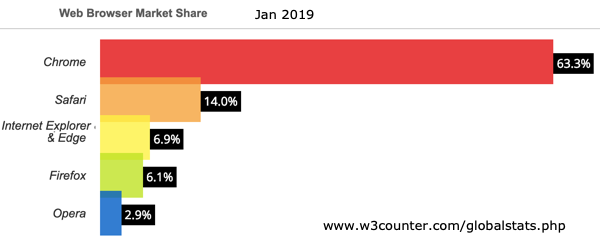
Source: W3Counter: Global Web Stats
Browsers use by Platform - Jan 2019:
| Platform | Total | Chrome | Safari | IE | Edge | Firefox | Opera | Chrom-
ium |
| Android | 40.6% |
88.1% |
|
|
|
0.5% |
1.5% |
| Windows | 30.3% |
66.2% |
|
12.0% |
4.9% |
9.6% |
1.7% |
| iOS | 12.7% |
4.2% |
93.1% |
|
|
0.1% |
|
| Mac | 5.0% |
53.9% |
38.6% |
|
|
6.5% |
0.5% |
| Linux | 1.9% | 53.7% | 1.0% | | | 34.9% | 1.7% | 7.9% |
| Chrome OS | 1.8% | 100% | | | | | |
| webOS * | 1% | 54% | 42% | | |
| RIM OS † | 0.04% | | 81% | | | | 12% |
| Xbox | | | | 10.3% | 88.2% | | | |
Total
desktop
& mobile | | 64% | 17% | 4.7% | 2.0% | 5.2% | 0.9% | |
* Web OS - OS developed for Palm smart phones, acquired by HP and used on HP smartphones bought by LG for smart TVs, refrigerators and watches.
†RIM OS - Former Research In Motion (Blackberry) is now marketed by TLC (Telephone Communication Limited) a Chinese company.
Source: Browser market share | NetMarketShare.com
See Historical Data below
Reviews:
A few years ago I googled browser reviews and Chrome always came up best.
At "The best web browser 2019" , TechRadar says "Firefox is back after a total overhaul, and has retaken its crown."
Firefox 57 (Quantum), released in November 2017, was a major enhancement with improvements in speed, privacy and user interface. The latest quantum upgrade, version 65, was released in Jan. 2019.
From Oct. 2018 to Jan 2019 Firefox usage has increased 7.2% while Chrome usage has increased 1.3%, although Firefox still is only about 10% of the desktop market compared to Chrome's 2/3.
35% of Linux users (the real power users) have Firefox.
At Brian X. Chen's June 20, 2018 NY Times article "Firefox Is Back. It's Time to Give It a Try., he says
"In months of using Firefox, there wasn't anything I wanted to do on Chrome that I couldn't also do on Firefox. Both browsers support 1Password, the popular password-management program. Both support extensions that prevent videos from automatically playing when you visit websites. And both support uBlock Origin, the ad blocker recommended by many security experts."
"Firefox especially stood out for some privacy features that are baked into the browser. Inside the privacy settings, you can turn on tracking protection, which blocks online trackers from collecting your browser data across multiple websites. With Chrome, you can install a third-party extension to block trackers -- but the fewer add-ons you have to tack onto your browser, the better."
Benchmarks:
Firefox's use of resources seems to have gotten worse since the original release of Quantum and Chrome is better on Windows.
Firefox is better than Chrome on the Mac OS, but Safari is best in terms of resources and speed.
Firefox 63 (end 2018) will have much-needed performance improvements on macOS
Best web browser for Mac - Macworld UK Nov 2018
| Chrome | Safari | Firefox | Opera | |
| JetStream score | 162.15 | 235 | 159 | 149 |
Jetstream - A performance benchmark test created by Apple - High is good
My tests in Feb 2019 on Mac OS X 10.14, with Firefox 63, and Chrome 72.
3 windows open, one with 10 tabs.
         Main process       Helper processes
        % CPU       RAM     Num   CPU        RAM
Chrome   2.8-10.6%  280 M   40    30%        4,300 MB
Firefox  1.3-4.3%   500 M    3     5%        1,800 MB
Safari   0.3-1.7    113 M    1    0.3-6.7%      42 MB
- What are all those helper processes in Chrome?
What is Google Chrome Helper, Why Does Chrome Use So Much Ram - Softlay says,
They are for extensions and plug-ins, but I have only 12 extensions and 40 helpers.
If you select Preferences under the Chrome menu and scroll down to advanced you will see a lot of services, these may be starting helpers.
Extensions under the Window menu will run helpers.
- Why does CPU usage keep jumping around. A couple of sites say because one or more of the pages you have loaded may be using Flash or Java which is causing it. But, I see it jump around with only one page without flash or java loaded.
Google Chrome vs. Firefox: Speed and performance comparison - Business Insider July 2018
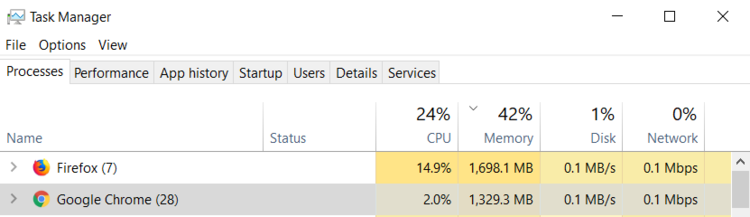
Best web browser 2019: Chrome, Edge, Firefox, and Opera face off | PCWorld Feb 2019
We took a look at CPU and RAM usage on Windows 10 by loading a set of 20 websites in a single window in quick succession. Once all tabs began loading, we waited 45 seconds, and then checked the CPU and RAM usage.
Firefox seems to have gotten slower since the original quantum release in Nov. 2017. However it was still had a better jetstream score, 120, than Chrome, 95
Opera was the best performer in terms of CPU usage by quite a bit, with Chrome coming in second (44%), followed by Edge, while Firefox was the biggest hog of them all (87%) this time around.
Chrome was best with memory of 840M vs Firefox with 1,892 M
At "Firefox Is Back. It's Time to Give It a Try. June 20, 2018 NY Times Brian X. Chen says,
"In my tests on a laptop running a script that automatically reloaded the top 10 news sites, Firefox lasted only a few minutes longer than Chrome before the battery was depleted. On another test, which involved streaming a Netflix video on a loop on each browser, the battery lasted about 20 minutes longer when the Chrome browser was used."
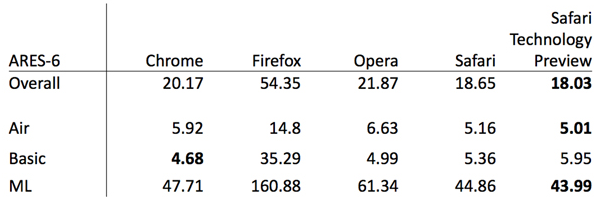

Safari Technology Preview is a beta for future versions of Safari to be released in 2019.
Rocket Yard Testing Lab: Which Browser is Fastest? | Other World Computing Blog
"Firefox has been upgrading its rendering engine with its newer Quantum technology. The Quantum technology is based on Servo, a new rendering system Firefox has planned for future releases. Quantum brings the most stable parts of Servo to Firefox today, which should result in better Firefox performance.
From our benchmark results, Firefox needs more of Servo to keep up and get ahead of the browser pack."
10 Top Mobile Web Browsers | LifeWire Dec 2018
| Chrome |
|---|
What We Like
- Well-known desktop browser with commanding market share.
- Many special features of Chrome on the desktop migrate to the mobile version.
- Data Saver tool makes browsing faster and more bandwidth-efficient.
|
What We Don't Like
- Google -- basically, the "giant sucking sound" of your personal data.
- Chrome's memory usage isn't optimal, on the desktop or on iOS.
|
| Firefox |
|---|
What We Like
- Sync between your Firefox browsers using Mozilla's sync capability.
- Plenty of extensions on Android to fine-tune your browsing experience.
|
What We Don't Like
- No extensions on iOS.
- No deep integration into either iOS or Android.
|
| Safari |
|---|
What We Like
- Optimized for iOS.
- Syncing of browser data through iCloud.
- Interface options designed to harmonize with the logic of iOS.
|
What We Don't Like
- Pretty much an Apple-only solution, in practice if not in theory.
- No meaningful ties to products and services outside the Apple ecosystem.
|
See Also:
10 Top Mobile Web Browsers | LifeWire
Best Browsers | Cnet (date unknown)
The best secure browsers 2018 | Security | Techworld
Historical Data
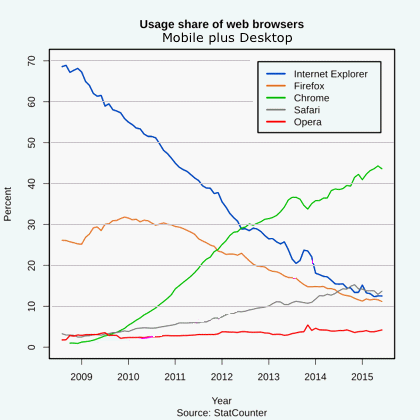
Old Data:
Market Share | Compatibility | Performance | Standards | Add-ons | New Features |
Obsolete tags/attributes | Tablet browsers | Bookmarklets
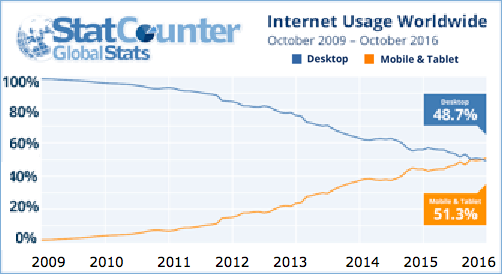
As of the end of 2017 beginning of 2018 mobile browser market share ranged from 39% in north america to 52% worldwide.
56% to leading US sites.
See more browser data.
Source: Desktop vs Mobile vs Tablet Market Share North America | StatCounter Global Stats
But in 2017 desktops still still accounted for 60% of time spent on web sites.
Source: Mobile vs Desktop Usage: Mobile Growing But Desktop Still Has Wins | Stone Temple
Here are the most popular mobile browsers a/o Sept '17 - feb '18:

            Android   iOS     all
Safari                96%    52% - 28% *
Chrome           88%   3.9%  41% - 62% *
Samsung Internet             4.5%
Opera                        1.4%
Android          6.4%        0.9%
UC                           0.7%
Firefox                      0.5%
Dolphin, Boat, Puffin and others were still in use at the end of 2017
Sources:
Mobile Browser Market Share United States Of America | StatCounter Global Stats
Browser market share | marketshare.com
* U.S. mobile browser market share 2017 | Statistica
Which browser is most popular on each major operating system? | ZDNet
Usage share of web browsers - Wikipedia
2016 data
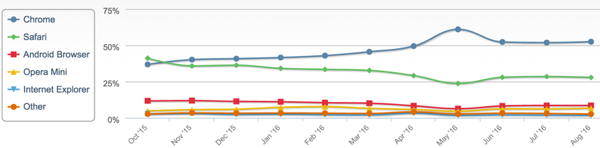
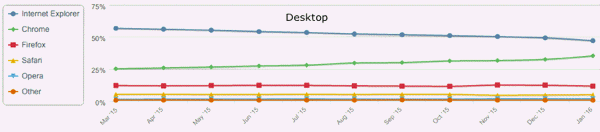
Source: Net Market Share - Mobile/Tablet, Desktop
Desktop
| Browser | 1995 | 2000 | 2005 | November
2010 | April
2011 | Oct
2011 | Change
/yr * | May
2012 | Aug.
2016 |
 Google Chrome Google Chrome | | | | 13.3% | 18.3% | 25% | 88% | 32.4% | 54% |
 Microsoft Internet Microsoft Internet
Explorer (IE) (all) | 2.9% | 79.1% | 90.9% | 48.2% | 44.5% | 40% | -17% | 32.1% | 27% |
| 9.0 (launched 3/15/11) | | | | | 2.3% | |
| 8.0 | | | | 29.5% | 30.2% | |
| 7.0 | | | | 11.9% | 7.8% | |
| 6.0 (launched 8/2001) | | | | 6.4% | 4.1% | |
 MS Edge MS Edge | | | | | | | | | 5.1% |
 Mozilla† Firefox (all) Mozilla† Firefox (all) | | | 6.0% | 31.2% | 29.7% | 26% | -15% | 25.6% |
7.7% |
| 4.0 (launched 3/22/11) | | | | | 7.6% | |
| 3.5+ | | | | 28.5% | 20.9% | |
| 3.1- | | | | 2.3% | 1.2% | |
 Apple Safari Apple Safari | | | 1.0% | 4.7% | 5.0% | 5.9% | 26% | 7.1% | 4.3% |
 Opera Opera | | 0.1% | 0.5% | 2.0% | 1.9% | 1.8% |
| Others | | | | 1.0% | 2.9% | | | 1% |
 Netscape † Netscape † | 80% | 19% | 0.1% | | | |
 AOL‡ AOL‡ | | ‡ | ‡ | | |
 SeaMonkey † SeaMonkey † | | | | 0.5% | |
* Change is annualized relative change computed from Nov. 2010 to October 2011. i.e. if Chrome goes from 10% of the market to 20% that is a 100% relative change. A minus 18% for IE means that they are loosing roughly 18% of their users per year.
Source: StatCounter at Sitepoint Blogs |
How Browser Market Share is Calculated
2000 and 2005 from TheCounter.com
The first Microsoft browser was licensed from Spyglass who delivered two versions of Mosaic to Microsoft. It was modified and released as Internet Explorer (IE) in 1995.
† - Mozilla was the internal codename for the development of the Netscape Navigator browser in 1994. The name is formed from "Mosaic killer"; Mosaic was the public domain browser developed by Marc Andreessen at the National Center for Supercomputing Applications (NCSA) at the U. Ill. Urbana-Champaign (UIUC) in 1993.
Mosaic was the first browser to display images inline with text instead of displaying images in a separate window and is credited with popularizing the World Wide Web.
Andreessen left UIUC to help found Netscape.
Firefox and the Firefox Logo are a trademark of the Mozilla.
SeaMonkey is a registered trademarks of the Mozilla Foundation.
‡ AOL bought Netscape in 1999.
In 2002, according to W3Schkools.com, AOL had a 5% browser market share and netscape had an 8% share. I couldn't find any other data for AOL.
In 2003, AOL signed a seven-year contract with Microsoft to use Internet Explorer layout engine in their products and as such AOL Explorer.
In 2008 AOL dropped support the Netscape browser.
See: Browsers at Internet History for more on the "browser wars" and the antitrust suit against Microsoft.
Mobile & Tablet Browser use 2015
Mobile devices accounted for 5% of broswer use.
Source: Mobile Devices Statistics - w3schools
| iOS | Android | Windows |
| 1.2% | 3.2% | 0.4% |
Source StatCounter
Browser market share | Marketshare
Count by OS: at NetApplications (NetMarketShare.com) May 2011
Windows 88.7%
Mac 5.3%
iOS 2.4%
Java ME 1.2% (Java Micro Edition for mobile devices, set-top boxes, ...)
Linus 0.9%
Android 0.8%
Screen Resolution:
In April 2011 99% of users had a screen resolution ≥ 1024x768
Source: Browser Display Statistics at w3Schools.com
|
|
In 2003 Apple released their own broswer, Safari, and Microsoft said it was stopping development on IE for the Mac; IE 5 was the last version. In 2005 apple stopped releasing IE with with OS X 10.4 and in January 2006 Microsoft removed the Mac version from their download site.
Performance:
There are many ways to measure browser performance, CSS rendering speed, javascript speed, page load time, CPU usage, application load time, ...
Best Mac Browser: Safari vs Chrome | notebooks.com Mar 2016
On newer hardware, the sorts of optimizations that these companies make to speed up their browsers, they're just not that noticeable. Safari wins most of the benchmarks - often by a substantial margin - but you'll find it doesn't make much of a difference in terms of everyday use.
Chrome uses battery faster.
Chrome has many more extensions
Your mobile devices can influence which browser you should use, as well. If you're a dyed in the wool Safari-on-iOS user, you might find the ability to open your Mac's Safari tabs on your iPhone or iPad worth the exclusivity. The same can be said if you use Android or even Chrome on iOS.
https://notebooks.com/2016/03/11/best-mac-browser-safari-vs-chrome/
Speedometer 1.0 BrowserBench.org:
Sept 2017 - 2.6 GHz Intel Core i5 Macbook
Safari 11: 100 +/- 7.7
Chrome 61.0: 112 +/- 1.7
Best Mac Web Browser 2017: 8 Alternatives to Safari - Macworld UK
Rating:
Safari 9/10
Chrome 8/10
Opera 8/10
Firefox 6/10
JetStream benchmark at above
Safari: 192
Chrome: 168
Opera: 166
Firefox: 138
In May 2011 Daniel Bailey at Mozilla: Browser Benchmarks Suck! | ConceivablyTech says,
"Taras Glek, a developer at Mozilla, recognizes that Mozilla has "traditionally relied on benchmarks (such as Talos, Sunspider or Kraken) to make Firefox faster, but now says that benchmarks "suck".
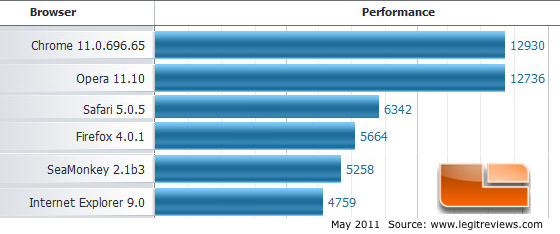
Source: What Web Browser is Fastest for Windows in 2011? - Benchmarking JavaScript, Flash and HTML 5 Performance on Internet Browsers - Legit Reviews (unresponsive in 2015)
 Others:
Safari 8 browser on Yosemite shows major speed boost - CNET
Peacekeeper - The Browser Benchmark from Futuremark Corporation
Browser Benchmarks:
Speedometer 1.0
Safari 8 browser on Yosemite shows major speed boost - CNET Oct. 2014
Sunspider benchmark scores (lower is better): June, 2015
Mac OS X 10.10
Browser ver  score
Chrome  43.0  174
Firefox 38.0  210
Safari   8.0  215
Internet Explorer (modern)93.1ms
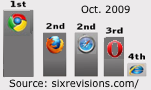
Web Browser Performance 2009 at SixRevisions.com
Web Standards Support:
When Netscape 4 and IE 4 implemented Cascading Style Sheets (CSS), around 1997, their support did not match the W3C standard (or, indeed, each other). Starting with IE 6 (8/2001) Microsoft started to implement the standards.
Many web pages had to have exceptions (quirks mode) for IE 5 and below.
With IE 5 at < 0.1% of market share now, these exceptions are being dropped.
HTML5 is an evolving standard, but as April 2011 IE 9, Firefox 4, Chrome 11 and Safari 5.1 had implemented 85% of the proposal.
They keep leapfrogging each other. Safari was ahead until Firefox 4. Safari is expected to retake the lead with 5.1, then Firefox with version 5. Chrome 12 will probably put it ahead.
See:
HTML5 & CSS3 Support, Web Design Tools & Support - FindMeByIP
The HTML5 test - How well does your browser support HTML5?
CSS3 & HTML5, Digital Marketing, Analytics & Deep Blue Sky
The HTML5 test - How well does your browser support HTML5?
Browser or Layout engines:
Most web browsers are modular with a user interface component and layout engine.
The layout engine (sometimes called a browser engine or rendering engine) takes the web page and processes the content, HTML, XML, Images, CSS, XSL, etc, to format it for the screen. They are shared by different browsers, e-mail clients and on-line help systems. Common ones are:
See: Web browser engine - Wikipedia,
and Technology News: Developers: KHTML vs. Gecko vs. Trident vs. Presto: Behind the Browser
New Features:
IE 9 and Firefox 4, both introduced in March 2011, let you block sites from tracking your movements online (via a tracking cookie, for example). These are primarily used by third parties (another web site which provides adds to the site you are visiting) and are used to target adds to things you seem to be interested in.
See: Privacy and third-party cookies at Wikipedia
Most major browsers, including IE9 and Firefox 4, now feature simplified interfaces with fewer toolbars than before, and take up less of the screen than older browsers.
See: Compared: IE9 and Firefox 4 Release Candidate | PCWorld
Add-Ons, Plug-Ins and Extensions:
Plug-Ins are applications like Adobe Acrobat pdf readers which will open in a browser window.
Add-Ons and Extensions are small bits of code which add functionality or change the look and feel of the browser itself.
They are most popular in Firefox and Chrome. SeaMonkey also accepts most add-ons for Firefox.
The most popular are Add blockers which eliminate most adds from the web pages you access.
See:
Web Browser Add-Ons, Plug-Ins, Extensions, Skins, and More at about.com
Firefox add-ons here.
Dave McRitchie's extensive Firefox Extension List
Chrome Extensions at chrome.google.com/webstore and ChromeExtensions.org
Bookmarks
Shortcuts for adding bookmarks:
Cmd-D - Mac
Ctrl-D - windows
Bookmarklets are java code in bookmarks that can modify a page, pass information from a page or provide special functions like erasing cookies.
See Bookmarklets in JavaScript.
and Bookmarklets here
Deprecated (Obsolete) Tags/Attributes:
Many html tags (e.g. Codes in web pages for formatting text, e.g. underline, center, frames, font size and face, ...) were eliminated in HTML 4 which was the current standard in 2011. However, most browsers continue to support them and will probably do so according to current until the end of the decade (2018-2020). They are being replaced by other HTML codes and Cascading Style Sheet (CSS) controls.
See:
Deprecated HTML tags and alternatives at CodeHelp.co.uk
Privacy:
Like most browsers, and pretty much anything else with an Internet connection these days, Chrome sometimes comes under fire for privacy issues. Not that it's giving your data away, but it might not always camouflage it as much as you'd like.
Links:
Firefox Is Back. It's Time to Give It a Try
Tablet browsers (Dolphin, Opera Mini, Opera Mobile, Chrome, Boat, ...)
Peacekeeper - The Browser Benchmark from Futuremark Corporation
Usage share of web browsers - Wikipedia
Comparison of web browsers - Wikipedia
What's the Best Browser for Windows, OS X, iPad, Android and More? | Lifehacker UK
10 Best Web Browsers For Android
Compare Security Features in Internet Explorer with and without Secure IE Browser Security
Browser Statistics at w3Schools.com
Browser usage stats - March 2011: Tech News
CNET Browser Reviews
Timeline of Web Browsers
Source: Timeline of web browsers - Wikipedia
Internet History
 </PRE>
 </BODY>
 </HTML>
|
 Computing
 Internet Browsers
.svg)