Politics
Polarization
Politics
Polarization
| Home
Politics
Polarization
|
|
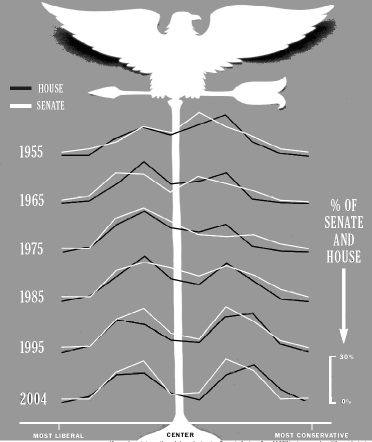
This chart above comes from a June 23, 2005, New York Times article "One Nation, Divisible" , points out that in 1955 33% of house members and 39% of senators were centrists while it was 8 and 9% in 2004. They attributes polarization to political redistricting, which makes seat safe for representatives with more extreme views which extended to the Senate as House members moved up. |
|
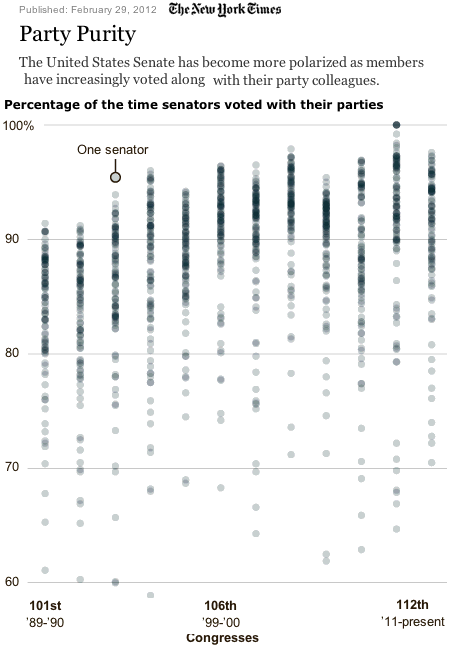
A February 29, 2012, article "After Many Tough Choices, the Choice to Quit" about Main Senator, Olympia Snowe's decision not to run again, talks about the difficulties of being a centrist. It points out, "Ben Nelson of Nebraska, the senator often considered the most conservative Democrat, and Ms. Snowe, seen as the most liberal Republican, will both be gone next year, as will Senator Joseph I. Lieberman of Connecticut, an independent who left a Democratic Party that would not tolerate his pro-Iraq war stand. They follow a parade of centrists out the Senate doors in recent years, including the Democrats Blanche Lincoln and Evan Bayh; a Republican-turned-Democrat, Arlen Specter; and two Republicans-turned-independents, James M. Jeffords and Mr. Chafee." |
|
As anger over the state of politics increases apathy, "only the most rabid partisans vote," so political strategists steer campaigns to issues that turn them on, said former Republican governor of New Jersey and Environmental Protection Agency administrator, Christie Whitman, who supports abortion rights. For Republicans, those are often social issues like abortion, gay marriage and contraception. But the rise of a new strain of fiscal conservatism has also led to moralistic portrayals of votes on spending and the debt limit. And when issues are framed around morality, compromise becomes very difficult.
"You can't compromise with someone who's amoral," she said. There is an indication that the general public is becoming more polarized. Several reasons have been proposed for the polarization.
The Migration Effect:
No more Conservative Democrats in the South
At the same time many republicans were more socially liberal and economically conservative. Teddy Roosevelt, McKinley's VP was a progressive republican. He didn't like what Taft was doing and created "The Progressive Party" a.k.a. "The Bull Moose Party". Both he and Taft got beat by Woodrow Wilson.
The progressive republicans started moving to the democratic party.
Janis's Groupthink:
The Echo Chamber Effect:
In military circles, this process is called "incestuous amplification." Among psychologists, it is known as "group polarization." In a nutshell: Like-minded people, talking only with one another, usually end up believing a more extreme version of what they thought before they started to talk. More choices in media, Fox and MSNBC instead of just ABC, NBC and CBS, and a multitude of Internet based media choices, blogs, facebook friends, etc. contributes even more to this process. In "The Wisdom of Crowds" by New Yorker business columnist James Surowiecki, he argues that "under the right circumstances, groups are remarkably intelligent, and are often smarter than the smartest people in them." Four elements required to form a wise crowd: (1) diversity of opinion; (2) independence of members from one another; (3) decentralization; and (4) a good method for aggregating opinions.
In a 2014 article, "Liberal Donors Pollute Politics, Too" they say, This arms race escalates every campaign cycle, producing a torrent of attack ads that make all candidates look like liars, cowards and thieves, increasing cynicism that keeps people away from the polls."
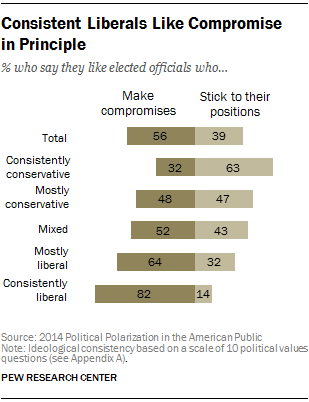
Liberals are more likely to compromise:
Gerrymandering:
Republican Shift to the right: In Eisenhowers famous Farewell Adddress he warned of the power of the Military Industrial Complex. In 2017 the Military and big business seem to be gaining more power than ever.
Republican hardball strategies:
In the 1994 midterms his "Contract with America" 10 bills Republicans promised to pass if they took control of the House. 300 candidates signed it. See Republican Hardball: Gingrich to McConnell and Trump Books - Articles: Why WeÕre Polarized, 2020, Ezra Klein Does Gerrymandering Cause Polarization? - "Find very little for such a link."
Kidding Ourselves: The Hidden Power of Self-Deception, 2014 by Joseph T. Hallinan
Links: "Two little questions to revive the lost art of compromise", By Chris Satullo, WHYY, Philadelphia (NewsWorks) Polarization - ChangingMinds.org Group Polarization: The Trend to Extreme Decisions -- PsyBlog Are the Media Biased? Politics and Science
| |