Politics
U.S. Government
The Supreme Court
Politics
U.S. Government
The Supreme Court
| Don's Home
Politics
U.S. Government
The Supreme Court
| Contact |
Under Construction 
How Scalia's Death Could Transform 2016 | Vanity Fair Supreme Court Web page (www.supremecourtus.gov) Justices Ranked from more liberal to more conservative. See MQ scores below.
Note: Justice Sotomayor was new and didn't have a score when we last updated this, so she was placed where general opinion thought she would fit. 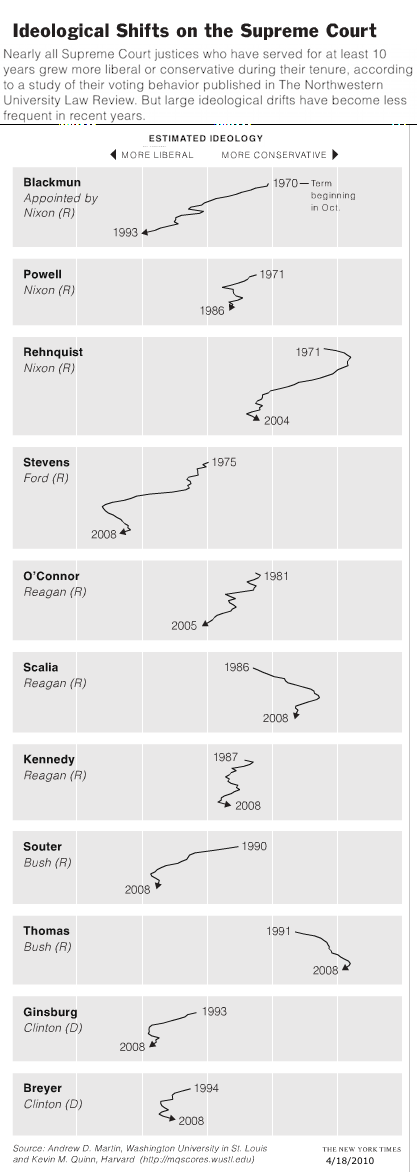 In an April 18, 2010, NY Times Article, Supreme Court Memo - Why Newer Appointees Offer Fewer Surprises they point out:
"A 2007 study by Professor Segal and three other scholars - Lee Epstein, Andrew D. Martin and Kevin M. Quinn - found that all but 4 of the 26 justices who have served for at least 10 years since 1937 changed over time. "Twelve moved to the left, seven to the right and three in more exotic ways," the study concluded. This is less true of recent appointees. Nominees' backgrounds these days often include work for the executive branch in Washington and substantial service on a federal appeals court, so more is know about how they might handle federal issues. Justin Driver, a law professor at the University of Texas, has a theory about why that might be so. "It's the friends factor," he said. Conservatives with established social networks in Washington, he said, are less likely than newcomers to be swayed by the city's relatively liberal political culture. "In the conservative imagination," Professor Driver said, "there is an idea that Republican-appointed justices are worn down by Georgetown dinner parties." See: Ideological Drift Among Supreme Court Justices: Who, When, And How Important?, by Lee Epstein, Andrew D. Martin, Kevin M. Quinn & Jeffrey A. Segal* at the Northwestern University Law Review A recent controversial decision was: "Citizens United v. Federal Election Commission", (2010): The court ruled that the government may not ban political spending by corporations in candidate elections, based on the First Amendment. Majority - Kennedy, joined by Roberts, Scalia, Alito, Thomas. Dissent - Stevens, joined by Ginsburg, Breyer, Sotomayor The dissenting justices did support Part IV which upheld the disclosure, disclaimer, and reporting requirements. Thomas did not support Part IV. | |||||||||||||||||||||||||||||||||||||||||||||||||||||||||||||||||||||||||||||||||||||||||||
|
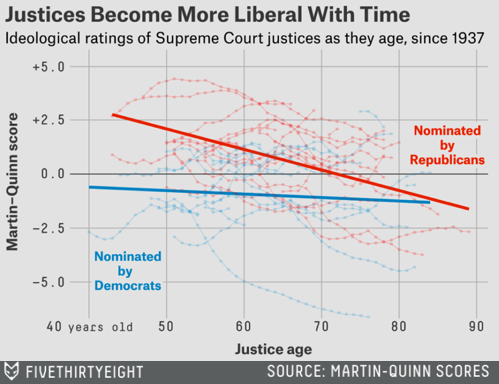
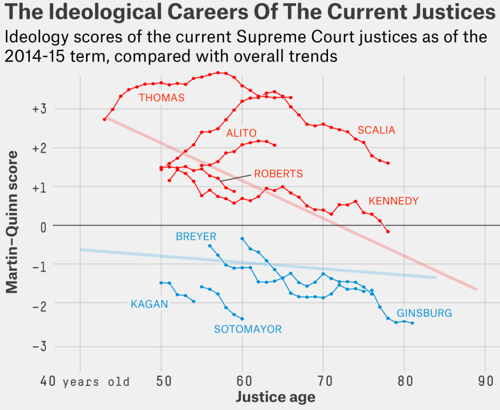
Supreme Court Justices Get More Liberal As They Get Older | FiveThirtyEight
A typical justice nominated by a Republican president starts out at age 50 as an Antonin Scalia and retires at age 80 as an Anthony Kennedy. A justice nominated by a Democrat, however, is a lifelong Stephen Breyer. FiveThirtyEight writer, Oliver Roeder, speculates on the causes of this trend.
In a broadcast "The Supreme Court, Explained" at On The Media, Greenhouse said it's the justices who come from outside of the Washington influence sphere that change the most.
At The Behavior of Supreme Court Justices
When Their Behavior Counts the Most
By Geoffrey R. Stone
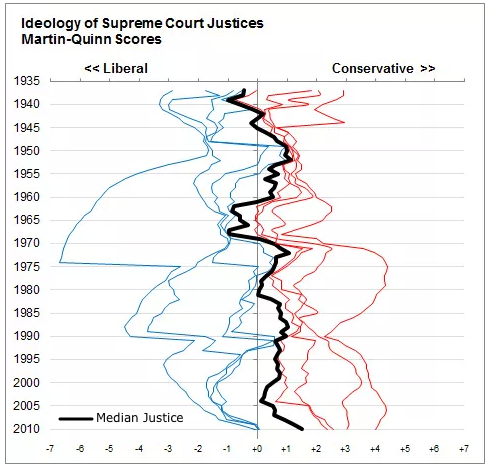
September 2013 he states, 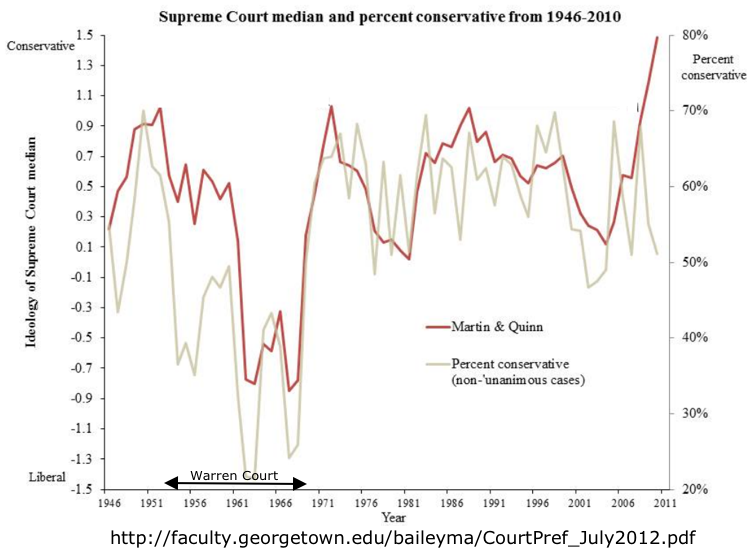 Source: Measuring Court Preferences, 1950 - 2011: Agendas, Polarity and Heterogeneity, Michael A. Bailey - Department of Government and Public Policy Institute Georgetown University. This paper is about whether court scoring methods provide valid intertemporal measures. "Intertemporal choice" is an economic term for how decisions at one point in time influence future decisions. eg. Saving now can result in more spending in the future. The paper is over my head, but the chart shows the general liberal-conservative distribution over time. I didn't follow the explanation for the divergence of the MQ scores starting in 2008. There have been criticism of the Martin Quinn scores because the case characteristics over time varies. The court has been mostly conservative except for the Warren Court when Earl Warren served as Chief Justice 1953-1969. Warren was succeeded as Chief Justice by Warren Burger. William O. Douglas and Earl Warren were the liberal mainstays of the court during this time Black and Brennan were liberal but not a consistently as Warren and Douglas.
Data thru 2015 at How Scalia Compared With Other Justices shows that the median justice (Kennedy) has moved back toward neutral.
It is interesting that 4 of the 5 most liberal justices were nominated by a Republican, Warren, Marshal and Brennan were nominated by Eisenhower, Stevens by Ford . Douglas was nominated by Roosevelt. There have been criticism of the Martin Quinn scores because the case characteristics over time varies.
Links: How Scalia's Death Could Transform 2016 | Vanity Fair Supreme Court Memo - Why Newer Appointees Offer Fewer Surprises - NYTimes.com Martin-Quinn Scores : Description Ideological leanings of U.S. Supreme Court justices - Wikipedia, the free encyclopedia Biographies (pdf) Supreme Court Justices Liberalism in Civil Liberties and Economics Cases 1937-1994, Professor Timpone - Ohio St. Famous Trials and Supreme Court Decisions The Constitution - Amendments - Major Acts of Congress Supreme Court at us.gov The Self-Correcting U.S. Supreme Court, by Bruce A. Desmarais University of North Carolina Biographies Return toPolitics
| |||||||||||||||||||||||||||||||||||||||||||||||||||||||||||||||||||||||||||||||||||||||||||